
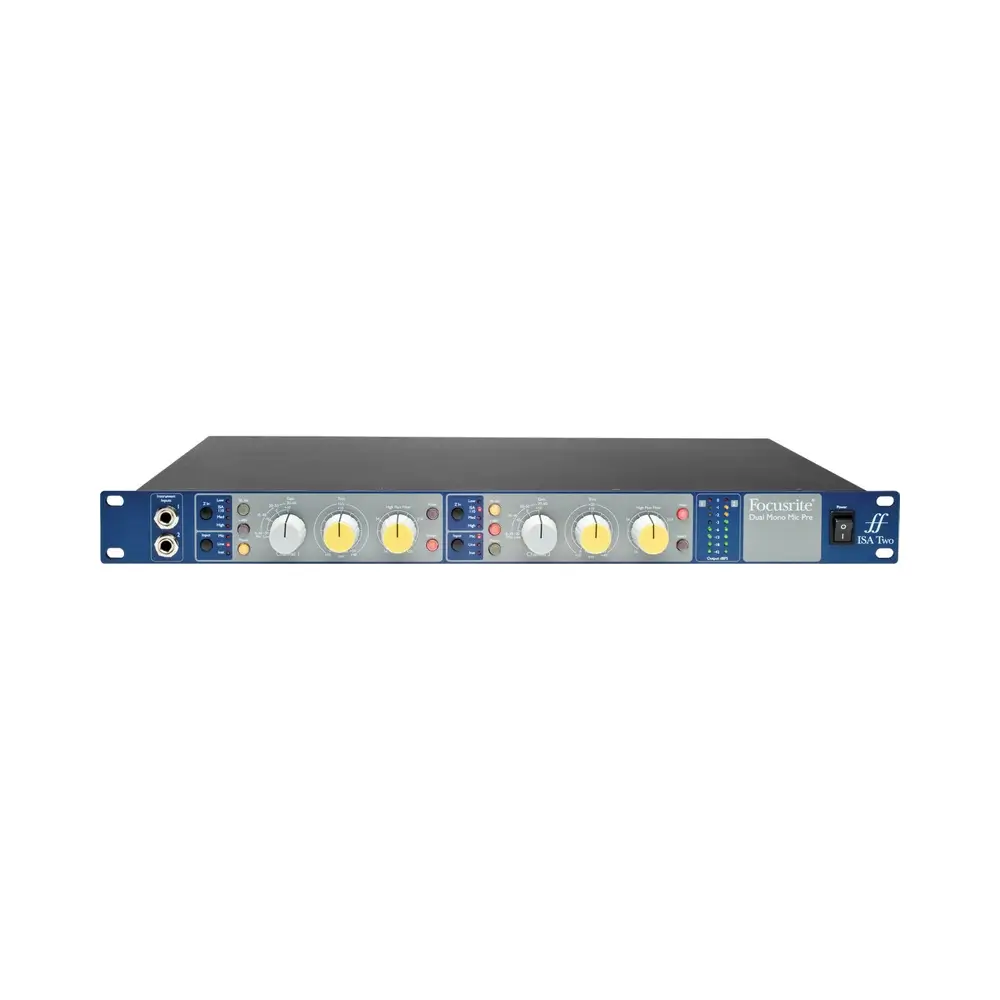
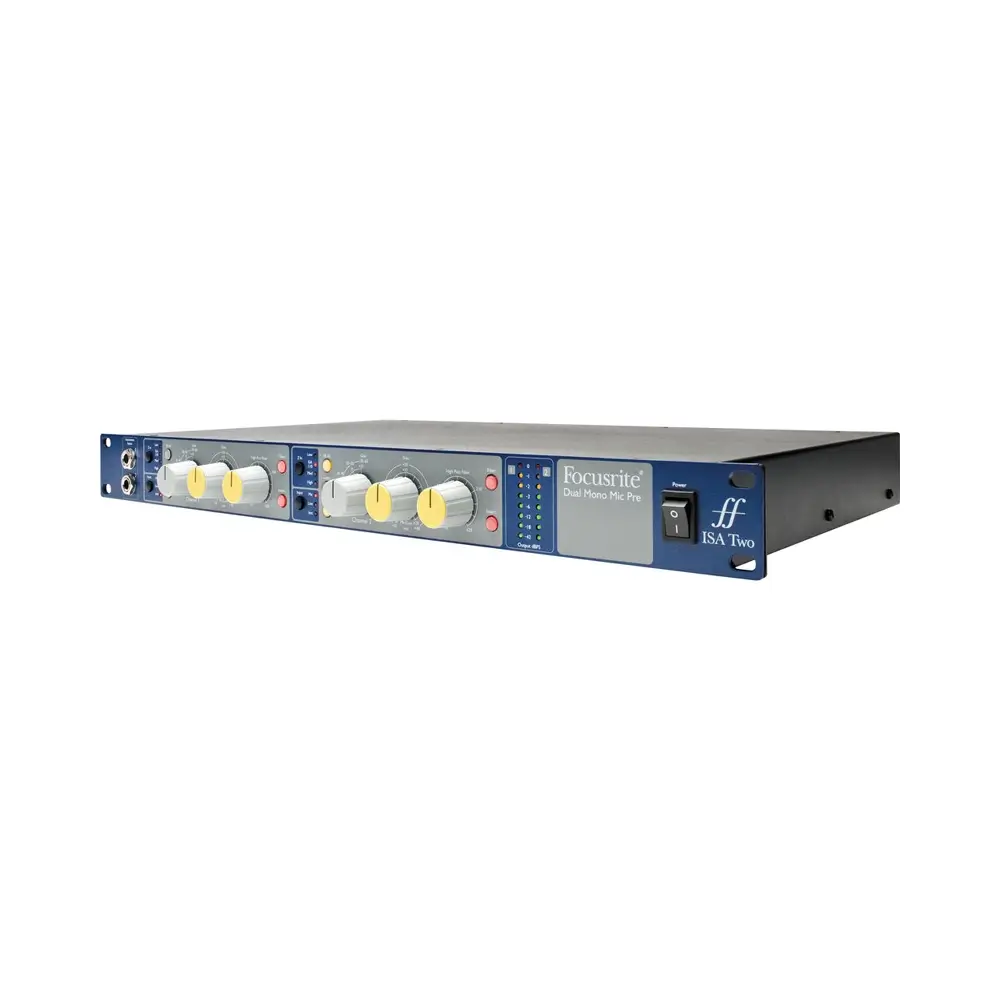
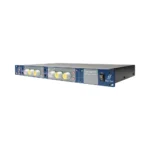
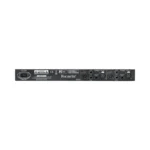

Focusrite ISA Two Rackmount 2-Channel Microphone Preamp
3,795.00 Excl. VAT
- Lundahl LL1538 mic input transformer
- Up to 80 dB of gain
- Variable input impedance
- User-calibrated metering
- Front panel instrument and rear panel line inputs
- Variable cut-off high-pass filter
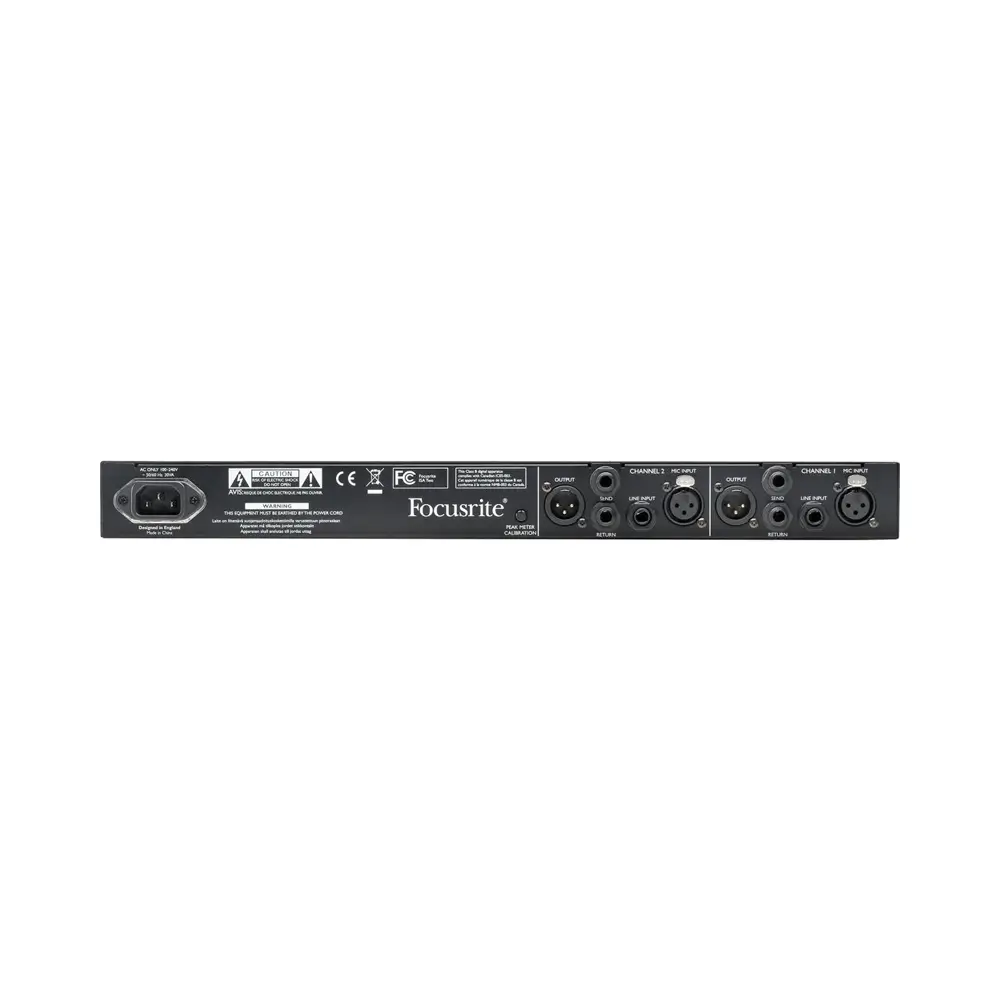
- Rear panel balanced inserts
Available on backorder
ISA Two
2-channel Microphone Preamp

Two channels of classic Focusrite mic pres
Focusrite’s ISA Two brings together a totally independent pair of classic ISA microphone preamps from the original ISA 110 module, combining the best of traditional solid-state electronics with the original input transformer specified by Rupert Neve – the Lundahl LL1538.
Each mic pre has the option of mic, line or the front-panel instrument input, with variable input impedance to ensure you are getting the best performance from the source. Up to 60dB of gain is available on the first four-position rotary and gain range switches, with a further +20dB of continuously variable trim, meaning a huge 80dB of gain is available should it be required. The high-pass filter features variable cut-off frequency between 16 and 420Hz. A pair of 8-segment LED meters show peak signal level in dBFS, while a rear-panel pot allows calibration to suit your A-D converters. Rear-panel insert points allow the use of inline processors such as compression.
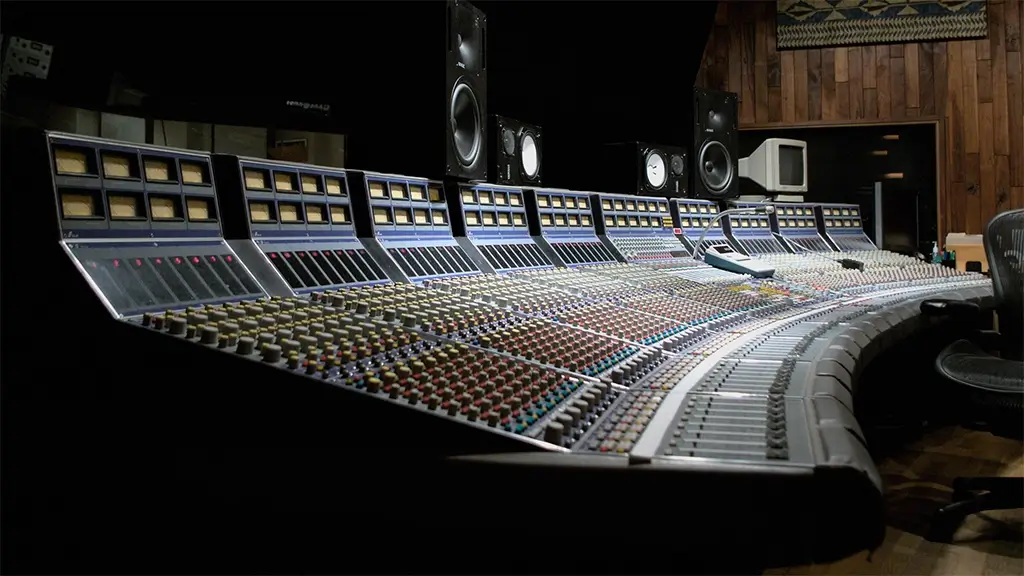
Focusrite’s ISA Two brings together a totally independent pair of legendary ISA microphone preamps from the original ISA 110 module, combining the best of traditional solid-state electronics with the original input transformer specified by Rupert Neve — the Lundahl LL1538. Two is a nice round number ideal for recording, say, a vocal and an instrument, or a stereo piano. But though you may only need two mic pres, you owe it to your craft to choose the best. (And if you need more, we offer ISA 428 Mk II 4-channel and ISA 828 8-channel units too.)
We’ve made one little adjustment to the mic pre. The original ISA 110 had a single input impedance that was ideal for the mics of the time. We’ve added three more, allowing you to get the very best out of any microphone, vintage or modern. Give a vintage mic the input it expects to get a traditional, warm sound. Pair the ISA Two with modern microphones and get the most transparent sound imaginable. Or experiment and pull out the inner character of any microphone you care to try. Couple that with up to 80dB of gain and you can be ready for anything.
In addition to the mic pres, there are front panel instrument inputs for instant access, along with rear-panel line ins. There’s also a balanced insert point on the rear panel, actuated with a front-panel button so you can insert the EQ, dynamics or other processors you need. Add to that the user-calibrated 8-LED metering and variable cutoff high-pass filter and you know that with the ISA Two you’ll have everything you need to get the highest quality sound into your recordings.
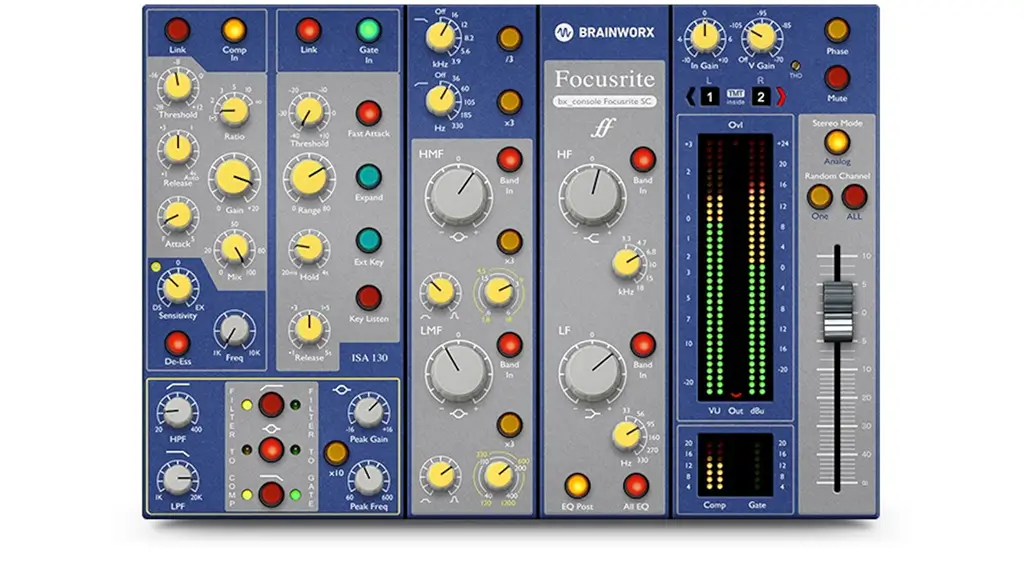
Brainworx bx_console
The Focusrite Studio Console reborn in your DAW
| Weight | 5.85 kg |
|---|---|
| Dimensions | 41.15 × 39.37 × 23.62 cm |
| Analog Inputs: | 2 x XLR, 2 x TS (inst), 2 x TRS (line), 2 x TRS (Return) |
| Frequency Response: | 10Hz-135kHz |
| Phantom Power: | Yes |
| Power Supply: | Standard IEC AC cable |
| Rack Spaces: | 1U |
| Gain Range (Mic): | 0 dB to 60 dB in 10 dB steps, plus 0 dB to 20 dB continuously variable trim |
| EIN (Mic): | Measured at 60 dB of gain with 150 O source impedance and 22 Hz-22 kHz band pass filter -127 dB |
| Noise (Mic): | Noise at output with unity gain (0 dB) and 22 Hz-22 kHz band pass filter -97 dBu |
| Frequency Response (Mic): | At minimum gain (0 dB)-0.5 dB at 10 Hz,?-1 dB at 135 kHz, relative to 1 kHz |
| At 60 DB Gain (Mic): | -6 dB at 10 Hz, -1 dB at 115 kHz, relative to 1 kHz |
| Crosstalk Channel To Channel (Mic): | Mic input, with I/P = 0 dBu, gain = 0 dB @ 1 kHz input to channel A, channel B output = -85 dB |
| Gain Range (Line): | -20 dB to 10 dB in 10 dB steps, plus 0 dB to 20 dB continuously variable trim |
| Input Impedance (Line): | 10 kO from 10 Hz to 200 kHz |
| Frequency Response (Line): | At minimum gain (0 dB)-0.3 dB at 10 Hz, -1 dB at 80 kHz, relative to 1 kHz |
| Crosstalk Channel To Channel (Line): | Line input, with I/P = 0 dBu, gain = 0dB @ 1 kHz input to channel AChannel B output?= -91 dB |
| Gain Range (Instrument): | 10 dB to 40 dB continuously variable trim |
| Input Impedance (Instrument): | 2 MO |
| Noise (Instrument): | Measured with 22 Hz-22 kHz band pass filterMinimum gain ( 10 dB) = -95 dBu |
| Frequency Response (Instrument): | At minimum gain ( 10 dB)-0.1 dB at 10 Hz,?-1 dB at 115 kHz, relative to 1 kHz |
| At Maximum Gain ( 40 DB) (Instrument): | -2.5 dB at 10 Hz, ?-1 dB at 110 kHz, relative to 1 kHz |
| HPF Roll-Off: | 18 dB per octave (3 pole filter) |
| HPF Frequency Range: | Continuously variable from 16 Hz to 420 Hz (-3 dB) |
Related products
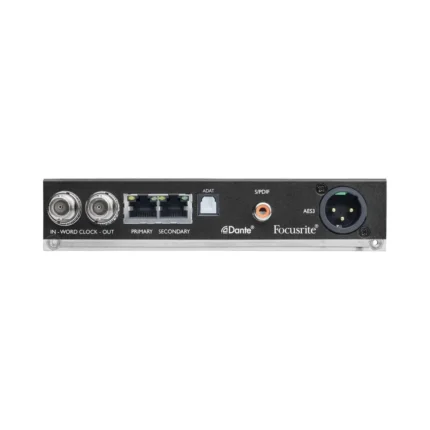
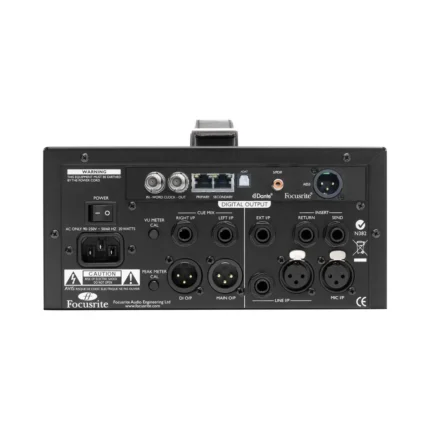
Focusrite ISA ADN2 Two-Channel A-D Card for ISA One
- Two-channels of high-quality, precision A/D converter for ISA One
- Up to 24-bit/192kHz sample rate
- Dante connectivity via Primary and Secondary Ethernet ports
- Two-channel XLR connection for AES3 output
- Two-channel RCA connection for S/PDIF output
- Two-channel TOSLINK connector for ADAT output
- Word Clock I/O on BNC connectors
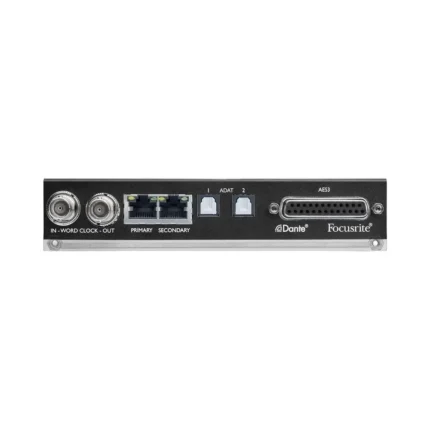
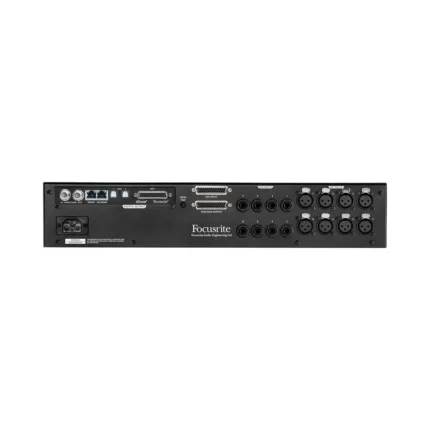
Focusrite ISA ADN8 8-Channel A-D Card for ISA 428/828 MkII
- Eight-channels of high-quality, precision A/D converter for ISA 428 MK2 and ISA 828 MK2
- Up to 24-bit/192kHz sample rate
- Dante connectivity via Primary and Secondary Ethernet ports
- Industry standard eight-channel AES59 DB25 output connection for AES3
- Two TOSLINK connectors for ADAT
- Word Clock I/O on BNC connectors
- RedNet Control and Dante Controller software allow Dante routing and control

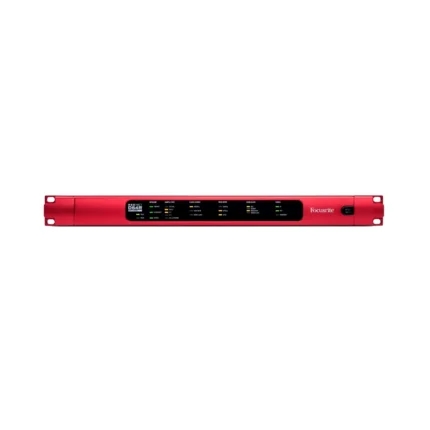
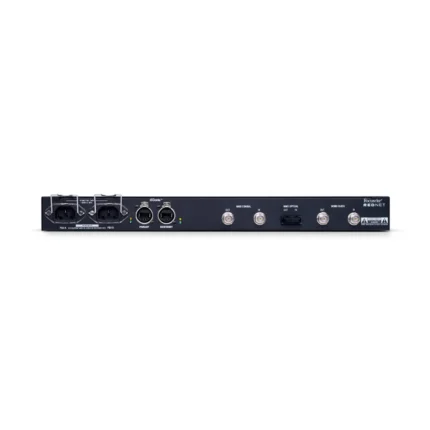
Focusrite RedNet D64R 64-Channel MADI-Dante Bridge
- Connects a MADI system and a Dante network seamlessly together.
- Connect Dante to digital mixing consoles, interfaces and cards that use MADI
- Built-in redundancy
- Supports both coax and optical interfaces
- Slave either the Dante system or MADI streams to an external clock.
- Supports up to 64 channels of digital audio I/O
- Sample rate conversion (SRC) on each input and output
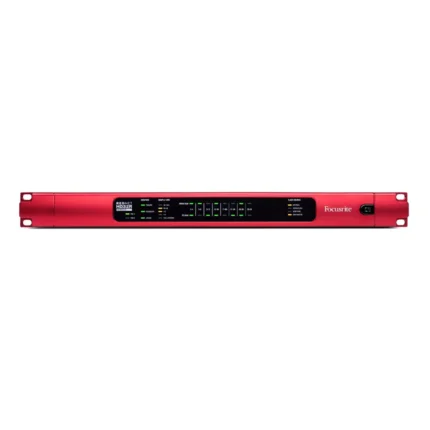
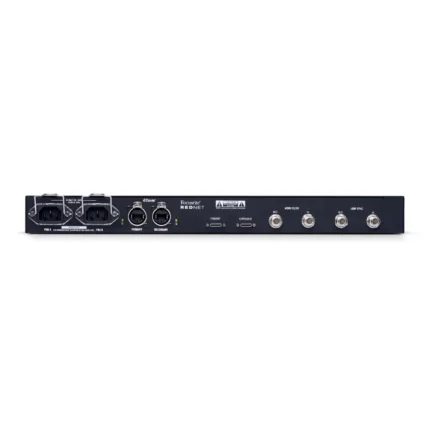
Focusrite RedNet HD32R 32-Channel Dante Networks Pro Tools | HD Bridge
- Allows Dante Ethernet-based audio networking products to interoperate w/ PT|HD & PTls|HDX .
- Ethernet and power supply redundancy
- Provides the vital link to an extensive high-quality audio network on standard Cat 5e or Cat 6
- Cost-effectively increase audio I/O
- Permits multiple workstations to access the same interface hardware and I/O.
- No changes to Pro Tools workflow required
- Up to 32 I/O with Pro Tools|HD over single DigiLink
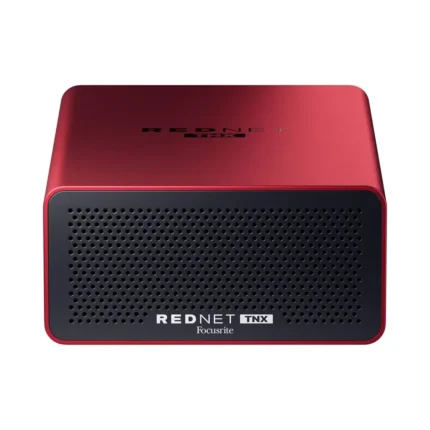
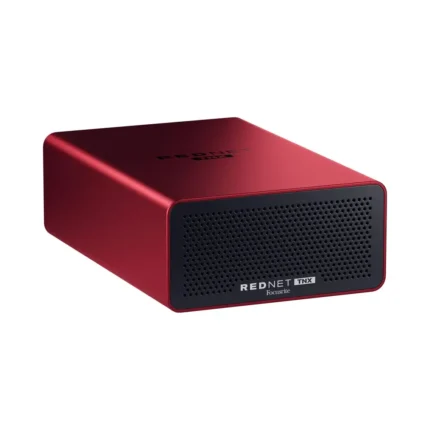


Focusrite RedNet X2P 2×2 Dante Audio Interface with Red Evolution Mic Pres
- Two of our best preamps provide ultra-clean gain, stereo linking
- individual phantom power, a high-pass filter, phase reverse and Air mode.
- High-quality conversion, with over 118dB dynamic range.
- Power-over-Ethernet allows a single cable to deliver audio, control and power to RedNet X2P.
- Local input mix allows 'more-me' style monitoring for easy foldback control.
- Mic stand mount keeps the unit out of the way and within reach.
- Local control lockout of mic pre settings, output settings or both.